Three cameras. Two seams. One joint optimization.
Self-supervised calibration of a camera rig from the stream itself: homography and radial distortion learned jointly, no targets, no lab session.
1. The question
A multi-camera device leaves the factory calibrated and drifts: heat, drops, a lens that moves a few microns. Recalibrating with a target means a lab, a technician and downtime. What changes at a different distance, and can the device learn it from what it already sees?
2. Method
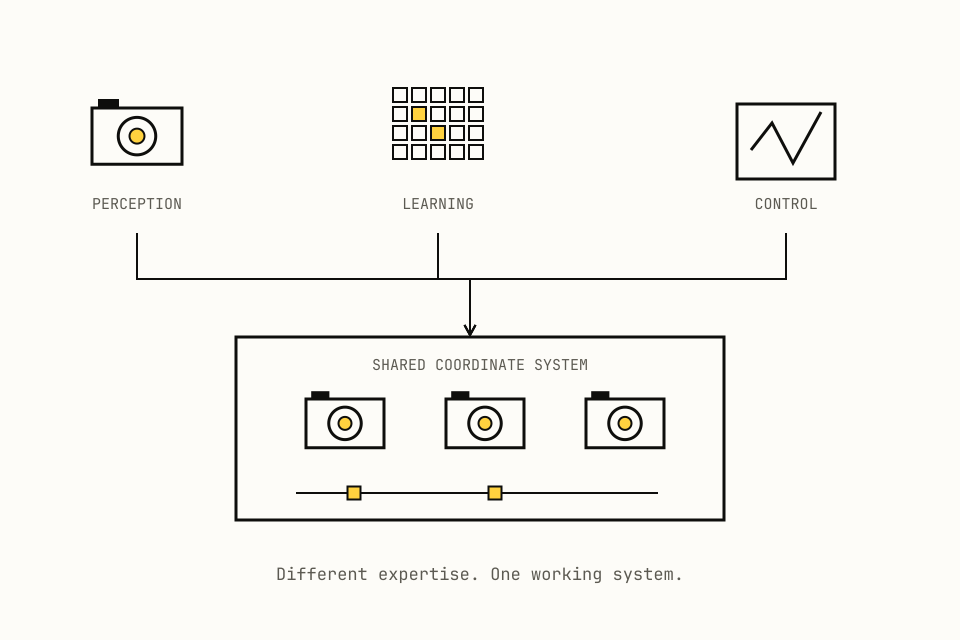
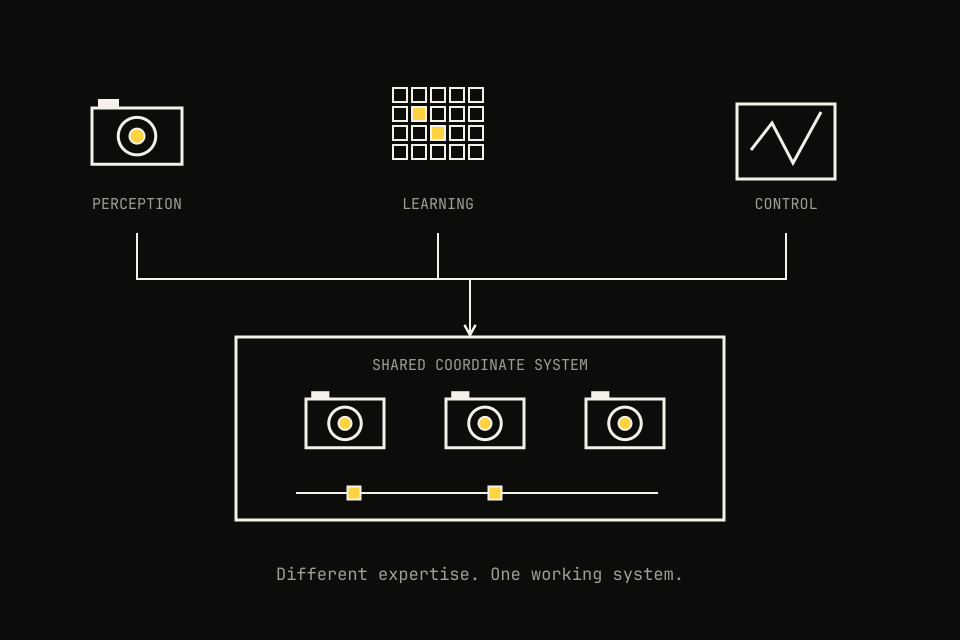
The rig is modelled as three sets of radial distortion parameters and two homographies in a shared coordinate system. A self-supervised objective aligns the seams on the live stream; a fixed-point flow inversion keeps the estimate stable. No calibration targets; the scene is the target.
- Joint estimation of homography and radial distortion, rather than one after the other.
- Explicit geometry first, learned residuals second, so the budget stays small enough for the device.
- Evaluated against the classical pipeline on synthetic rigs and on hardware.
3. What we can report
The method is in production. Deployment figures belong to the client and are not reported; the synthetic-rig evaluation is available on request with task, setup, metric, baseline, date and source.
4. Transfer
The client's engineers own the code, the evaluation harness and the documentation.
One line about the problem is enough. We reply within a day.
letsbuild@aiolilabs.com